Homework Tracking for Schools: A Practical System
Homework tracking that parents and students can follow: how to set, record and follow up homework, with a routine and a template your teachers can copy.

Key takeaways
- Homework tracking works when every task is written in one place with a clear due date, visible to both the student and the parent.
- The quality of the task and the feedback matters more than the amount set, so track fewer, better tasks.
- Follow up patterns, not single misses: a student who misses three in a row needs a conversation, not a detention slip.
"I didn't know there was any homework." Every school office has heard that sentence from a parent, usually in the same week a teacher has written "homework not done again" in a report.
Both of them are telling the truth, and that is the real problem. Homework tracking is how a school makes sure that every task is written down once, with a due date, in a place the student and the parent can both see, and that someone notices when work stops coming in. This article is for heads of school, office staff and teachers who want a simple system that works across the whole school, not just in the classroom of the one teacher who is very organised.
What the evidence says about homework
Before designing a system, it helps to know what is worth tracking. The Education Endowment Foundation's Teaching and Learning Toolkit rates homework as low cost with a positive average impact. For primary school pupils the impact is about +2 months, from limited evidence.
The EEF's most useful point for office and leadership teams is this: well-designed tasks and good feedback matter more than the amount set. That changes what a tracking system is for. It is not there to count how many worksheets went home. It is there to make sure a good task reaches the child, gets done, and gets a response.
Why does homework go missing?
When you look at missed homework across a school, the reasons tend to fall into a few groups.
| Reason | What it looks like | What fixes it |
|---|---|---|
| The task was never seen | Set verbally at the end of a lesson, student was absent or not listening | Write every task down in one shared place |
| The due date was unclear | "Next lesson" when the class has two teachers | Always record an actual date |
| The task pile-up | Four subjects due on Thursday | A weekly pattern per year group |
| No one at home knew | Parent finds out at the parents' evening | Parents can see tasks and due dates |
| No consequence or feedback | Work handed in, never returned | Teachers record that it was checked |
| Something else is going on | Missed homework and missed days together | Link homework to attendance follow-up |
The last row matters. A student who stops doing homework is often a student who is also starting to miss school. If your office already looks at attendance, homework patterns belong in the same conversation. Our guide on how to improve school attendance covers that side.
Setting up homework tracking across the school
Agree one format
Every task should have the same four pieces of information:
- Who it is for: a whole class, a group, or one student.
- What to do: one or two plain sentences. A student should understand it without having been in the lesson.
- When it is due: a real date, not "next time".
- How it will be returned: handed in, brought to the lesson, or checked in class.
If a task needs a worksheet or a page number, include it. If it needs a login to another site, say so.
Choose one place
A homework planner in a student's bag is fine for the student. It does not help the parent who never sees the bag, the office who takes the phone call, or the head of year looking for patterns.
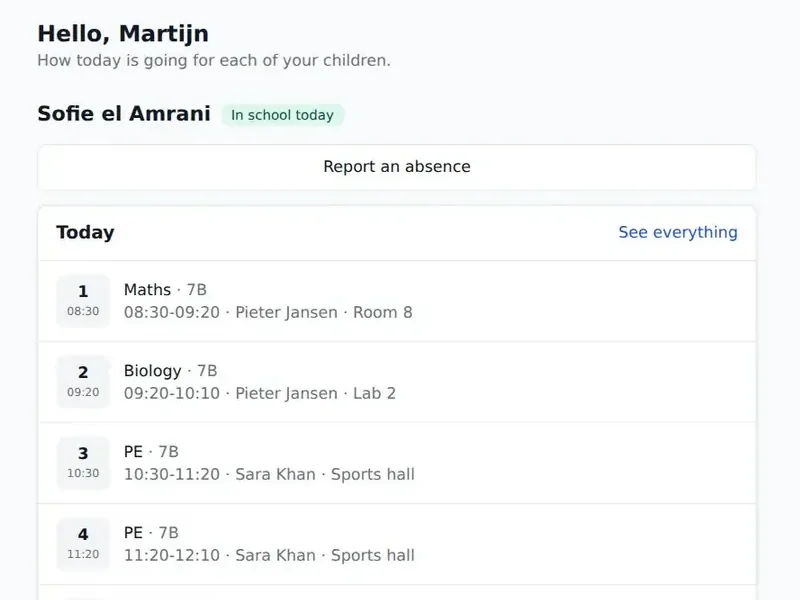
Choose one place where every teacher records every task, and where students and parents can look. In StudaHub, teachers set homework for a class or for one student, and parents and students see it with due dates in their own view. Parents install nothing: it runs in the browser on their phone after they accept the school's invitation.
Set a weekly pattern
Agree which subjects set homework on which days for each year group. This is simple to draw up once your timetable is in place, and it stops the Thursday pile-up. Share the pattern with parents at the start of the year so they know what a normal week looks like.
Decide who follows up what
Be explicit about responsibility, because otherwise everyone assumes someone else is handling it.
- The teacher marks whether each task was handed in and gives feedback.
- The form tutor or class teacher looks for students missing work across several subjects.
- The office or head of year contacts the family when a pattern appears.
- The head of school reviews the homework pattern termly with staff.
How do you follow up on missing homework without nagging?
The aim is to catch a pattern early, not to punish every miss. A single missed task is normal. Three in a row, or missed work in several subjects in the same fortnight, deserves a conversation.
When you contact a family, keep the tone warm and specific. Something like: "Amira has missed her last three maths tasks. She is doing well in class, so we wanted to check whether something is getting in the way at home." That message gives the parent a fact, a positive, and an open question.
Parents are more likely to help when they have been kept in the loop all along. The EEF finds that parental engagement adds on average about 4 months' additional progress over a year. Letting parents see homework and due dates is one of the easiest forms of engagement a school can offer. When a wider message is needed, for example a reminder about a project deadline for a whole year group, the office can send it to parents of that class. In StudaHub there is a preview before it goes out, which saves a lot of embarrassing corrections.
Homework tracking for different kinds of school
Primary schools. Keep tasks short and regular. Reading at home is often the main homework, so record it simply. Parents are the audience as much as the child.
Secondary schools. Students should take ownership, so give them their own view of tasks and due dates. The office's job is spotting cross-subject patterns.
Weekend and supplementary schools. Six days pass between lessons, so a clear written task matters even more. A short note after each session is often enough. See our guide to weekend school management for a full Saturday routine.
A homework tracking template to copy
Use this as a starting point, whether you keep it in software, a shared spreadsheet or on paper.
For each task
| Class or student | Subject | Task | Set on | Due | Handed in | Feedback given |
|---|---|---|---|---|---|---|
| Year 5 Blue | Maths | Times tables sheet, rows 6 to 9 | Mon 6 Oct | Mon 13 Oct | 24 of 27 | Yes |
| Year 5 Blue | Reading | Read chapter 4, note two new words | Wed 8 Oct | Fri 10 Oct | 27 of 27 | Yes |
Weekly checklist for form tutors
- Every task this week has a real due date
- No more than the agreed number of tasks due on any one day
- Students missing two or more tasks this week are noted
- Any student also missing lessons is flagged to the office
- Feedback returned on last week's tasks
Termly checklist for leadership
- Review the weekly homework pattern with staff
- Check that parents can see tasks for their child
- Sample tasks for quality: clear, purposeful, possible without help
- Remove tasks that are set out of habit rather than for learning
Where to start with homework tracking
Start small. For the next half term, ask every teacher to write every task in one place with a real due date. That single change solves the most common complaint, the parent who did not know.
Then add the weekly pattern, then the follow-up routine. Good homework tracking is not about more homework. It is about fewer, better tasks that everyone can see. If you want to set that up in one system with separate views for teachers, parents and students, StudaHub's first 3 months are half price, and you can see what each role gets on the roles overview.
For a system that does this out of the box, see homework tracking in StudaHub, where students and parents see the same homework the teacher set.
Frequently asked questions
What is the best way to track homework in a school?
Use one shared place where teachers record every task with a class, a short description and a due date, and where students and parents can see it without asking. Agree a school-wide format, check it weekly, and follow up patterns of missed work with the family rather than chasing individual tasks.
Should parents be able to see their child's homework?
Yes, in most schools this helps. Parents who can see what is due can ask the right question at the dinner table and plan the week. Keep it to the task and the due date. Parents do not need to see every other child's work, only their own child's.
How much homework should schools set?
There is no single right amount. The Education Endowment Foundation says well-designed tasks and good feedback matter more than the quantity set. Agree a sensible weekly pattern per year group so tasks do not pile up on the same night, and review it with staff each term.
Who should check whether homework was done?
The teacher who set it, after the due date, so the record is accurate and the follow-up comes from the person who knows the work. Parents can support by seeing what is due and whether it was handed in. The office and head only need the overview, for example which students are missing work week after week.
When should a school follow up on missing homework?
After the second missed piece in a short period, not at the end of term. One missed task is usually a conversation with the student. A run of missed tasks is a pattern worth sharing with parents early, while there is still time to find out what is getting in the way.