Weekend School Management: A Guide for Volunteers
Weekend school management with volunteers and three hours a week: registers, parent contact, progress tracking and a Saturday routine you can copy this term.

Key takeaways
- A weekend school has little time, so every admin task must fit before the first lesson or in the ten minutes after the last.
- Write the routine down so any volunteer can run it; the school should not depend on one person's memory or phone.
- Track progress per child through a clear sequence of steps, so a teacher who changes next term knows exactly where each child is.
It is 9:40 on a Saturday. Doors open at 10. One teacher has messaged to say she is ill, the register is a printed sheet from last month with names crossed out in three colours of pen, and a parent at the gate wants to know why her son was marked absent last week when he was there.
If that sounds familiar, this guide is for you. Good weekend school management means doing a small number of things the same way every week: a register that takes seconds, a single place for student records, a clear way to reach parents, and a simple record of each child's progress. It is written for people who run Saturday schools, supplementary schools and language schools, usually as volunteers, with a few hours a week and no full-time office.
How is running a weekend school different?
A weekday school has an office staffed all week. A weekend school has perhaps three hours of teaching and a car park conversation. Everything has to fit into that window.
The people are different too. Your teachers may be parents, students home from university or retired professionals. They are generous with their time, but they come and go. Someone who kept the register perfectly for two years moves away, and the knowledge goes with them.
Then there is the gap between sessions. Six days pass between lessons. A child can forget a week of work, a parent can forget the school is closed for Eid, and a message sent on Wednesday may be read on Friday night or not at all.
So the goal of managing a supplementary school is not more admin. It is admin that survives a change of volunteer.
The four things to get right
1. A register that takes seconds
Your teachers have a room full of children and no time. Paper registers get lost, go home in handbags and are hard to add up at the end of term.
Whatever you use, the register should be quick to take on a phone and should not depend on good signal, since many weekend schools meet in community centres, mosque basements or sports halls. In StudaHub a teacher takes the register on a phone in under twenty seconds, and it works offline: marks are saved on the device and sync when there is signal again.
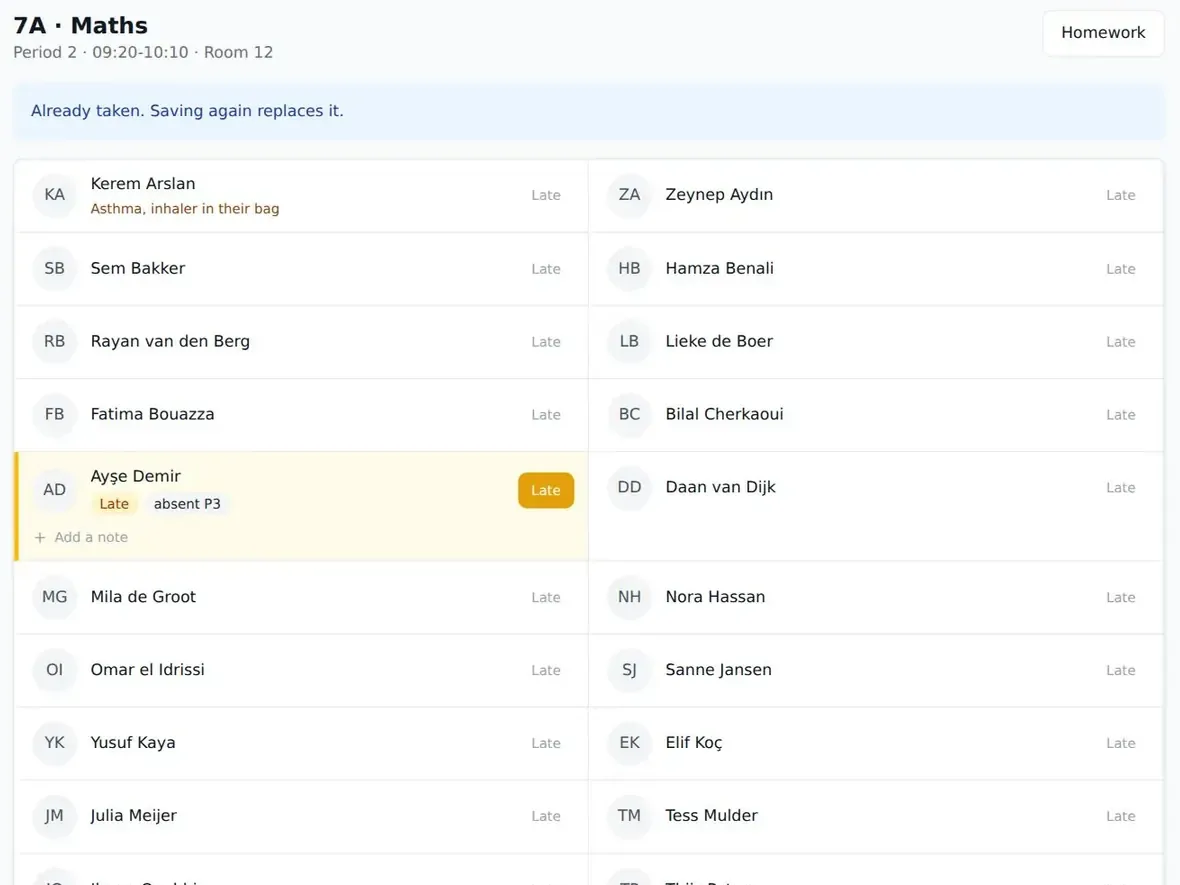
Attendance matters in a weekend school just as it does on weekdays. Attendance Works defines chronic absence as missing 10% or more of school days. For a school that meets 35 Saturdays a year, that is only four Saturdays. A child who misses one in every eight sessions is already there, and nobody may have noticed.
2. One place for student records
Many weekend schools run on a mix of a founder's spreadsheet, a WhatsApp group and a folder of paper forms. That works until someone needs an allergy note at 11:15 and the person who has the spreadsheet is not in today.
Put everyone in one shared system with separate logins for each volunteer. If your records are in a spreadsheet now, keep them tidy, one row per child, and you can import them later. StudaHub imports students and guardians from a CSV file, and it recognises column headings in English, Dutch, French, German and Turkish, such as Achternaam or Nom, so you do not have to rename them first.
Remember that small schools still hold personal data about children. The basics of GDPR for schools apply to you: collect only what you use, keep medical notes to the people who need them, and never keep the only copy on a personal phone.
3. A clear line to parents
Parents in a weekend school are often your best allies and your hardest-to-reach audience. They drop off, go shopping and pick up.
Decide on one official channel for school news and stick to it. Group chats are friendly, but important messages get buried under photos and thank yous. Send a short message after each session if homework was set, a reminder the week before a closure, and a same-day message when a child is missing without explanation.
The Education Endowment Foundation finds that parental engagement adds on average about 4 months' additional progress over a year. For a school that sees children for three hours a week, what happens at home between Saturdays matters even more. Our article on school parent communication goes into tone and frequency.
4. Progress through a sequence
Most weekend schools teach something with clear steps: reading levels in a heritage language, grammar units, music grades or a text learned by heart. That is a gift, because progress can be recorded simply.
For each child, record which step they are on, the date they completed each earlier step and who heard or assessed them. Then a new teacher in September does not have to start from scratch with each child.
StudaHub calls these learning tracks: progress through a sequence, such as reading levels or memorisation, recorded per child.
A sample progress record
Here is what a simple progress record might look like for one child. The format works on paper or in software.
| Step | Completed | Heard by | Notes |
|---|---|---|---|
| Reading level 1 | 14 Sept | Teacher A | Reads aloud with confidence |
| Reading level 2 | 21 Sept | Teacher A | |
| Reading level 3 | 5 Oct | Teacher B | Needed two attempts |
| Reading level 4 | In progress | Practising at home |
Once a month, look across the whole class. The child who has been on the same step for six weeks is the one to talk to, and usually the conversation is with the parent.
How do you share the work among volunteers?
A small team works best when each person owns one thing. A typical split for a school of 60 to 120 children:
- Coordinator (head of school): decides policy, handles difficult conversations, signs off on anything new.
- Registrar: keeps records up to date, enrols new families, sets up logins.
- Communications volunteer: writes to parents, checks replies before Saturday.
- Teachers: take the register, set homework, record progress.
Give each person access to what they need and no more. A teacher needs their own class, not every family's phone number. In StudaHub each of the five roles has its own login and view, and permissions come with sensible defaults, so a new volunteer does not accidentally see everything.
Your Saturday routine, copy and adapt
Print this or pin it to the staff room door.
Before the first lesson
- Check messages from parents reporting absence since last week
- Confirm every class has a teacher; arrange cover if not
- Open the rooms and check the first aid box
During the first ten minutes of each lesson
- Take the register
- Note any child who arrives late
After the register
- Coordinator or registrar checks unexplained absences
- Send a message to parents of any child missing without explanation
Before going home
- Teachers record progress steps completed today
- Teachers note homework set for the coming week
- Lost property into the box, rooms locked
Once a term
- Fifteen minute handover meeting for all volunteers
- Review attendance for children missing more than one session in ten
- Remove access for volunteers who have left
- Share a short progress summary with each family
Keeping costs sensible
Weekend schools usually run on modest fees and donations, so per-student software fees add up quickly. Look for a flat price and check that every role you need is included. StudaHub charges a flat price per school, with the Small plan at €19 per month for up to 15 students and Medium at €49 for 16 to 99, and every plan includes every feature and all five roles. See pricing for the full list.
Where to start with weekend school management
Pick one thing this term. If your register is on paper, start there, since it is the base for everything else. If records are scattered, gather them into one tidy spreadsheet. If progress lives in teachers' heads, draw up the list of steps for each class.
Good weekend school management is a routine that any volunteer can pick up on a Saturday morning. Write it down, share it, and review it each term. If you want to do it all in one place, you can sign up for StudaHub with your school name and an email address, and the first 3 months are half price.
See how StudaHub works for weekend schools: a register for volunteers, a weekend timetable and parents who know what happened.
If you also run extra lessons or a tutoring group, our guide to tutoring centre management sets out a weekly routine for tutors and parents.
Frequently asked questions
How do you manage a weekend school with only volunteers?
Keep the admin small and written down. Give each volunteer one clear job, use a short checklist for Saturday morning, keep student records in one shared system rather than personal phones, and hold a fifteen minute handover at the end of each term. Most problems come from knowledge living in one person's head.
What records should a supplementary school keep?
At minimum: each child's name, class and date of birth, guardian contact details, medical or allergy notes, a weekly register, and a record of progress through whatever the school teaches, such as reading levels or a text learned by heart. Keep only what you use, and restrict sensitive details to the people who need them.
How can a weekend school track progress?
Break the programme into ordered steps, for example reading levels or units, and record the date each child completes each step and who heard them. Review the record monthly to spot children who are stuck. Share progress with parents so they can support revision at home during the week.
How much does software for a weekend school cost?
Look for a flat, low price rather than a fee per student or per volunteer, because weekend schools often run on small fees and donations. StudaHub, for example, costs 19 euros a month for a school of up to 15 students and 49 euros for 16 to 99, with every feature included and the first 3 months at half price.
Who should run the admin at a weekend school?
One coordinator should own the registers, the parent list and messages, even if they are a volunteer themselves. Teachers take their own registers and record progress. Write the weekly routine down so another volunteer can step in when the coordinator is away.