School Parent Communication: Tone, Channels and Timing
A practical guide to school parent communication: how to write about absences, homework and school news so families read it, trust it and act on it.

Key takeaways
- Sort every message by urgency first. Absence messages go the same morning; school news can wait for a weekly round-up.
- Use one main channel that every family can open on a phone, and keep group chats for informal chatter, not official news.
- Write short, warm, specific messages with one clear action, and preview them before they go out.
Picture a parent at 7:40 on a Tuesday. There is a school newsletter in their inbox, three unread messages in the class group chat, a paper slip at the bottom of a bag and a text about a trip. Somewhere in all that is the one thing they actually needed to know. Good school parent communication fixes this by doing a few simple things: send urgent, personal messages fast; bundle everything else on a predictable rhythm; and use one channel families can rely on.
This article is for office managers, heads of school and organisers of weekend schools and clubs who send most of the messages home. It covers the three kinds of message schools send most (absences, homework and general news), then tone, channels and how often to write, with templates you can adapt.
Why it is worth getting right
Communication with parents is not just admin. The Education Endowment Foundation's Teaching and Learning Toolkit finds that parental engagement is linked on average to about four months' additional progress over a year. That does not come from sending more messages. It comes from families understanding what their child is doing and how they can help.
Poor communication has a cost too. Parents who feel bombarded stop reading. Parents who only ever hear bad news stop answering the phone. And the office ends up chasing the same information again and again.
The three messages that matter most
Absences: fast, personal and calm
When a child is missing without explanation, the parent should hear the same morning. This is partly safeguarding (a child who left home and never arrived needs finding quickly) and partly habit: families who know the school notices tend to report absences in advance.
Keep these messages short and free of blame. The goal is information, not a telling-off. And make it easy for parents to report an absence themselves, so the message becomes the exception rather than the rule. The UK Department for Education's toolkit on communicating with families to support attendance has useful advice on tone, especially for families where attendance has become a worry. For the wider picture, see our guide on how to improve school attendance.
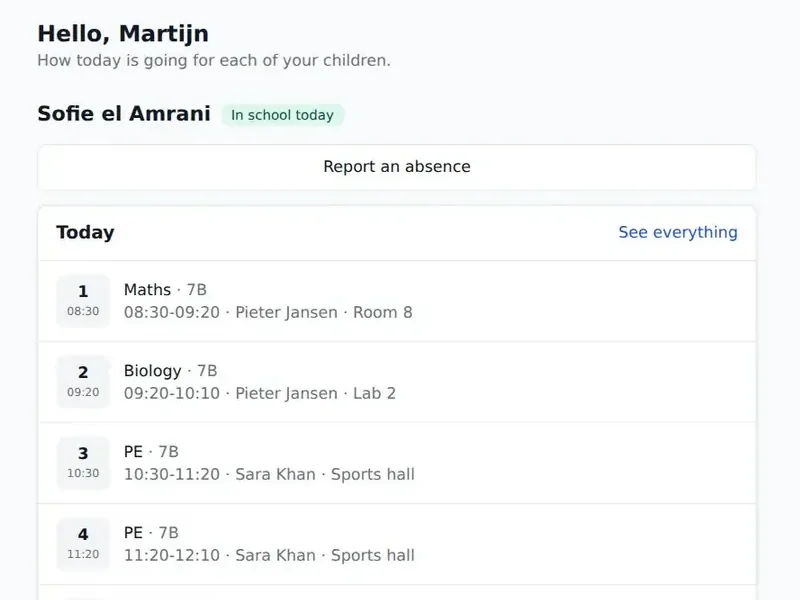
In StudaHub, parents get a message the same morning when their child is missing, and they can report an absence from their own phone.
Homework: visible, not announced
Homework is the message that most often gets lost, usually because it lives in a student's memory or a crumpled planner. The fix is not to message parents every time homework is set. It is to make homework visible in one place, with due dates, so parents can look when it suits them.
The EEF rates homework as low cost with a positive average impact, and for primary pupils suggests about two months' additional progress, from limited evidence. Their point is that well-designed tasks and good feedback matter more than the amount set. For parents, that means: tell them what the task is, when it is due and how they can help, not just that "there is homework". Our article on homework tracking goes into this further.
General news: bundled and predictable
Trips, closures, events, uniform reminders, term dates. None of these is urgent on its own, and sending each one separately trains families to ignore you. Bundle them into one regular message. Families learn that "Friday's update" has everything, and they read it.
Save separate messages for things that really cannot wait: a snow closure, a heating failure, a changed pick-up time today.
Tone: how to sound like a person
The best school messages read as if someone in the office wrote them to one family, even when they go to three hundred. A few rules help:
- Lead with the point. "School will close at 12:30 on Friday 16 October" before any explanation.
- One message, one action. If you need a reply, a form and a payment, consider whether that is really three messages.
- Use plain words. "Your child" rather than "the pupil". "Please let us know" rather than "parents are requested to inform".
- Be warm, not gushing. A simple "thank you" is enough. Exclamation marks lose their effect quickly.
- Think about who is reading. Some families read on a small phone, some in a second language, some between shifts. Short sentences help all of them.
- Read it back before sending. Check names, dates and which group it is going to. Most "sorry, please ignore" follow-ups come from skipping this step.
Which channels should a school use to reach parents?
Most schools use several channels without ever deciding what each one is for. It helps to write it down.
| Channel | Good for | Watch out for |
|---|---|---|
| School system with parent login | Absences, homework, official messages, records | Families need an invitation and an easy first sign-in |
| Longer letters, attachments, forms | Ends up in spam or unread folders | |
| Phone call | Sensitive conversations, repeated absence, worries | Time-consuming; note what was said |
| Paper letter | Legal notices, families without reliable phones | Gets lost in bags; slow |
| Parent group chats | Informal chatter between parents | Not official, shares phone numbers, no record |
| Face to face at the gate | Building relationships | Only reaches the parents who do pick-up |
Whatever you choose, pick one official channel and tell families clearly: "If it matters, it will come through here." Make sure it works on any phone, without asking parents to install anything, and that every family can actually get in. StudaHub gives parents their own login and view, and they sign in through an invitation the school sends. You can read more about how the five roles each see different things.
A word on data. Parents' contact details and children's attendance are personal information. The UK Information Commissioner's Office has resources for schools on children's information that are worth a read before you set up any new channel.
How often should a school message parents?
Here is a simple rhythm that works for many schools. Adjust it to your size and the number of days you are open.
- Same morning: any unexplained absence for that child.
- When set: homework visible to parents and students, with a due date.
- Weekly or fortnightly: one round-up of news, dates and reminders.
- Each term: a short note on progress, plus term dates for the next term.
- Only when needed: urgent notices such as closures.
For a weekend school that meets once a week, the round-up can go out the evening before each session. For a club, once a month may be plenty.
Templates you can copy
Adapt these to your own voice.
Same-day absence: "Good morning. [Name] is not in school today and we have not heard from you. Could you let us know they are safe and the reason for the absence? Thank you. [School] office."
Weekly round-up opening: "Here is this week's update. The one thing to do: [action, date]. Everything else is below."
Closure notice: "[School] will be closed on [day, date] because [reason]. Lessons start again on [day, date]. We will send an update if anything changes."
Checklist for your school parent communication plan
- Every message type has an agreed channel, written down.
- Families know which channel is the official one.
- Unexplained absences lead to a message the same morning.
- Parents can report an absence without phoning.
- Homework is visible with due dates, in one place.
- General news goes out as one regular round-up.
- Every message is previewed before sending: names, dates, recipients.
- Each message has one clear action, or says that no action is needed.
- Families without reliable phone access have another route.
- Contact details are kept up to date each term.
- You know who can send messages to the whole school.
Where to start
Good school parent communication is less about writing more and more about writing on purpose. This term, pick your official channel, set up same-day absence messages and move general news into one weekly round-up. Families will notice the difference within a few weeks, and so will your office inbox.
If you would like one place for absences, homework and messages to parents, StudaHub's first 3 months are half price, and the pricing is a flat price per school.
Frequently asked questions
What is good school parent communication?
Good communication between school and parents is timely, short, specific and kind. Parents hear quickly about things that affect their own child, such as an absence or missing homework, and get general news on a predictable rhythm. Every message says clearly what, if anything, the parent needs to do, and families can reply or report back easily.
How often should a school message parents?
Match frequency to urgency. Messages about an individual child's absence should go the same morning. Homework should be visible whenever it is set. General school news works best as one regular round-up, such as weekly or fortnightly, plus the occasional urgent notice. Families tend to stop reading when everything arrives as a separate message.
Is WhatsApp a good way for schools to communicate with parents?
Group chats are quick, but they mix official news with chatter, expose parents' phone numbers to each other and make it hard to know who has seen what. Many schools keep one official channel for school messages and records, and treat any parent group chat as informal. Check your data protection duties before sharing contact details.
Who should send messages to parents?
Absence messages and practical notices usually come from the office, so parents always know where they come from. Teachers send class news and homework, and the head sends whole-school messages and anything sensitive. Agree who sends what, so parents do not get the same message three times or none at all.
What should a school never send by group chat?
Anything about one child's absence, behaviour, health or results, and anything that needs a record of what was sent. Group chats mix official messages with chatter and share parents' phone numbers with everyone. Use a channel that reaches only the right parents and keeps a history.