How to Improve School Attendance: A Practical Guide
How to improve school attendance with first-day calls, early pattern spotting and real partnership with families. Practical steps any school office can use.

Key takeaways
- Contact the family on the first morning of an unexplained absence. Speed matters more than any other single step.
- Look for patterns (Mondays, Fridays, one lesson, one sibling group) before they turn into chronic absence.
- Treat families as partners. Ask what is getting in the way before you talk about rules.
If you want to know how to improve school attendance, the honest answer is not a poster campaign or a prize at the end of term. It is three habits kept up every single week: contact families on the first morning a child is missing, look for patterns before they harden, and treat parents as partners rather than suspects. Everything else supports those three.
This guide is for heads of school, office managers and anyone running a weekend school or after-school club who has watched the same few names come up on the absence list again and again. It is written from the office side of things, because that is where most attendance work actually happens.
Why does school attendance slip?
Before you pick strategies, it helps to be clear about what you are up against. When a child misses school often, the reason is usually a mix: a younger sibling who needs taking to nursery, a stomach ache that is really worry about a test, a parent working early shifts, a long bus ride in winter. Very few families decide one morning that school does not matter.
That is why attendance improves when schools get curious. The question "why wasn't she in?" asked kindly on day one gets a very different answer from the same question asked in a formal letter on day fifteen.
It also helps to agree on what "a problem" looks like. Attendance Works defines chronic absence as missing 10% or more of school days for any reason, excused or not. They point out that this is only about two days a month. That surprises many parents, and it is a good number to share with them.
Strategy 1: make the first-day call non-negotiable
If you only change one thing this term, change this. Every unexplained absence should lead to contact with the family on the same morning, ideally before break.
What makes it work:
- One owner. Decide who makes the calls or sends the messages. In a small school that may be the office manager; in a weekend school it may be a volunteer coordinator.
- A fixed time. Registers closed by 9:15, calls done by 10:00. When it has a slot in the day, it happens.
- A friendly script. "Hi, it's the school office. We noticed Amir isn't in this morning and wanted to check he's all right." No accusation, just care.
- A record. Note what the parent said and when. That note is what you will need if the pattern continues.
The first-day call does two jobs. It catches the child who set off for school and never arrived, which is a safeguarding matter. And it tells every family, quietly, that absence is noticed.
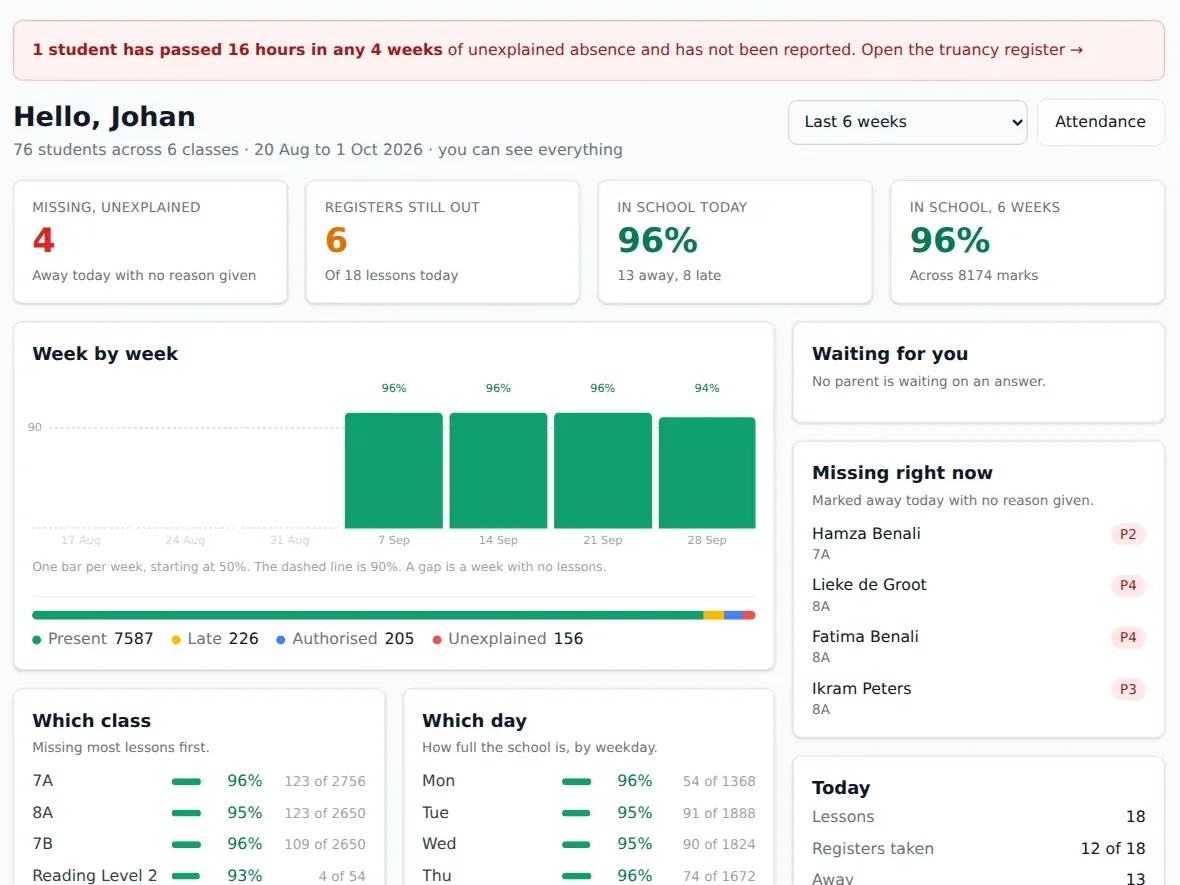
The practical barrier is time. If the office has to walk round classrooms collecting paper registers, then cross-check them by hand, the calls start at 11:00 and get skipped on busy days. This is where your register system matters. In StudaHub, for example, teachers take the register on a phone, the office sees every unexplained absence across the school in one list, and parents get a message the same morning. Whatever you use, aim for a list of missing children on the office screen within minutes of registration closing.
Strategy 2: spot patterns before they become problems
A single missed day tells you little. Five missed Mondays tell you a lot. Set aside twenty minutes each week to look at attendance as patterns rather than individual days.
Things worth looking for:
| Pattern | What it might mean | A sensible first step |
|---|---|---|
| Mondays or Fridays | Long weekends, family travel, a difficult start to the week | A friendly word with the parent about the pattern itself |
| One lesson or one day | Anxiety about a subject, a teacher or PE | A quiet conversation with the student and their teacher |
| Late marks turning into absence | Morning routines, caring duties, transport | Ask the family what the mornings look like |
| Siblings absent together | Something at home affecting the whole family | One joined-up conversation, not three separate letters |
| A sudden drop after good attendance | Illness, bereavement, bullying, a change at home | Contact quickly and gently; involve pastoral staff |
Once you know a child is heading towards the 10% line, you can act while there is still plenty of term left. Waiting until the end-of-term report is how a few odd days turn into a lost half-year.
Keep the categories honest
Pattern spotting only works if the data is right. Agree as a staff team what counts as authorised and unauthorised, and write it down. If one teacher marks "dentist" as authorised and another leaves it unexplained, your weekly review will show noise instead of real patterns.
Strategy 3: work with families, not against them
Parents are the people who get a child out of the door in the morning. If they feel judged, they stop picking up the phone. If they feel supported, they tell you what is really going on.
Some approaches that help:
- Start with a question. "Is there anything making mornings hard at the moment?" opens more doors than "attendance is below expected levels".
- Explain the numbers in plain terms. "Two days a month adds up to nearly four weeks a year" lands better than a percentage.
- Agree small, specific steps. A plan such as "in by 8:45 every day for the next two weeks, and we'll check in on Friday" is easy to keep and easy to praise.
- Praise improvement, not just perfect attendance. A child who goes from 85% to 93% has done something hard.
- Make reporting easy. If parents can tell you about an absence from their phone at 7:30, you spend less time chasing and more time helping.
The UK Department for Education has a useful toolkit on communicating with families to support attendance, with example messages and advice on tone. It is written for schools in England, but the principles travel well. For more on tone, channels and how often to write, see our guide to school parent communication.
Strategy 4: know your formal duties and your escalation steps
Support comes first, but every school also needs a clear, written escalation path. Staff should know exactly what happens at each stage so that nobody is treated differently because of who happened to be on duty.
A simple sequence many schools use:
- First-day contact for every unexplained absence.
- A conversation with the parent once a pattern appears.
- A meeting in school with an agreed plan and a review date.
- Involvement of pastoral or specialist staff if the plan is not working.
- Formal referral where the law or local rules require it.
The formal part depends on where you are. In England, the DfE's statutory guidance Working together to improve school attendance sets out what schools are expected to do. In the Netherlands, schools must report 16 hours of unauthorised absence within 4 consecutive school weeks to the leerplichtambtenaar through DUO's absence register. Keeping a running total by hand is error-prone, so it helps to have a system that collects unexplained absence past the line you set. StudaHub keeps a truancy register for exactly this purpose.
Strategy 5: make attendance everyone's job
The office cannot do this alone. Teachers see the child every day and notice the quiet ones drifting. Heads set the tone. Even students can help if they understand why it matters.
- Teachers take the register promptly and accurately, and mention concerns early rather than waiting for a formal review.
- The head talks about attendance in assemblies and newsletters, and backs the office when a hard conversation is needed.
- The office runs the first-day contact, the weekly review and the records.
- Families report absences early and tell the school when something changes at home.
In a weekend or supplementary school the same roles exist, just with fewer hours and more volunteers. Consistency matters even more there, because missing one Saturday means missing a whole week of learning.
A practical attendance checklist you can copy
Paste this into your staff handbook or pin it by the office phone.
- Registers close at a fixed time every day, and every teacher knows it.
- One named person makes first-day contact, with a named backup.
- Every unexplained absence gets a call or message before mid-morning.
- Parents have an easy way to report an absence before school starts.
- The office reviews attendance patterns every week, at the same time.
- Authorised and unauthorised categories are written down and agreed by all staff.
- Students approaching 10% absence are flagged and discussed.
- Every plan agreed with a family has a review date.
- Improvement is recognised, not only full attendance.
- The escalation path is written down, and staff know each step.
- You know your legal reporting threshold and who submits the report.
- Attendance data can be exported for reports and meetings.
How to improve school attendance: where to start
Knowing how to improve school attendance is the easy part. Doing it every week, through busy Mondays and staff absences, is where schools succeed or stall. Start with the first-day call this week. Add the weekly pattern review next week. Once both are routine, work on family conversations and your written escalation path.
If your current system makes those habits slow, it is worth looking at what good attendance tracking software for schools should do. StudaHub's first 3 months are half price, and you can see the pricing up front.
The habits above are easier with the right tools: see how StudaHub's attendance software flags unexplained absence the same morning.
Frequently asked questions
What is the fastest way to improve school attendance?
Call or message the family on the first morning a child is missing without explanation. It shows that someone noticed, it catches problems while they are small, and it makes the next conversation easier. Pair that with a weekly look at patterns so that the office acts before a few odd days become a habit.
What counts as chronic absence?
Attendance Works defines chronic absence as missing 10% or more of school days for any reason, whether excused or not. In a 180-day school year that is roughly 18 days, or about two days a month. It is a useful early warning line because it counts all absence, not just unauthorised days.
Should schools punish poor attendance?
Sanctions alone rarely fix the reasons a child stays home, such as anxiety, illness, caring duties or transport. Most schools get further by talking to the family first, agreeing a plan and following up regularly. Formal steps still have a place, and in some countries reporting is a legal duty, but they work best as a last stage.
Who is responsible for improving school attendance?
Everyone has a part, but one person should lead it. The office follows up absences the same day, teachers notice patterns in their own classes, the head sets the approach and families are partners in solving the cause. In many countries an attendance officer is involved once absence passes the legal threshold.
How quickly should a school contact parents about an absence?
The same morning, ideally within an hour of the register when no reason has been given. A fast first contact protects the child's safety, shows parents the school notices and stops a single day from quietly becoming a habit. Keep the first message short, friendly and factual.